
Why our Gas is Sustainable

Mankind has always used naturally occurring substances and resources for energy. The resources have always been appropriate to the level of technology that was available at the time. Although we have access to many types of energy, we think natural gas is one of the most efficient and timely resources available. One way to understand this is to take a long historical view of our energy sources and methods.
Historical Energy Sources
During the pre-industrial revolution (pre-1850), wood was a primary energy source. Starting around 1850, coal began to supplant wood. Coal then reached its peak in the early 1900s, before World War I. Shortly after that, oil and other liquid hydrocarbons replaced wood and coal as the predominant energy source.
Since then, oil has been the dominant energy source. The development of nuclear and natural gas in the mid-1970s challenged oil’s dominance. And now, up to speed with the energy industry today, solar and wind generation are also pushing into oil’s grip on energy.
Human history of energy usage is one of going from sources with more carbon to sources with less carbon. Robert A. Hefner III, the author of The Grand Energy Transition, provides some carbon-to-hydrogen ratios of our typical energy sources:
– Wood: ~10 Carbon atoms per 1 Hydrogen atom (10:1)
– Coal: ~2 Carbon atoms per 1 Hydrogen atom (2:1)
– Oil: ~1 Carbon atom per 2 Hydrogen atoms (0.5:1)
– Methane Gas: – 1 Carbon atom per 4 Hydrogen atoms (0.25:1)
Natural gas is 40 times less carbon-intensive than wood, 8 times less than coal, and 2 times less than oil. This spectrum also reflects technological advancements. Fusion energy, like generating power from the Sun, and what we now use for solar and wind energy, is carbon-free and hydrogen-based. We feel that sustainable natural gas will be a crucial fuel in bridging us to our next energy source.

The Case for Natural Gas
Historically, natural gas was viewed as a by-product of oil drilling. Oil was and still is the more attractive economic target. Fast-forward to today, and while natural gas has seen over a decade of low US prices, there has also been a dramatic increase in US natural gas usage. This is partly due to the vast amount of natural gas found throughout the US during the same timeframe.
This increased natural gas usage is starting to take effect. The US electrical generation industry has reduced its CO2 emissions from a high of 2,544 million metric tons (MMmt) in 2005 to 1,724 MMmt in 2019. This 32% reduction is almost entirely due to displacing coal with natural gas in electrical generation.
And that trend looks set to continue accelerating. As recently as 2022, electrical generation CO2 emissions further declined to 1,580 MMmt, representing a 36% reduction.
Gains to be Made in Exporting Gas
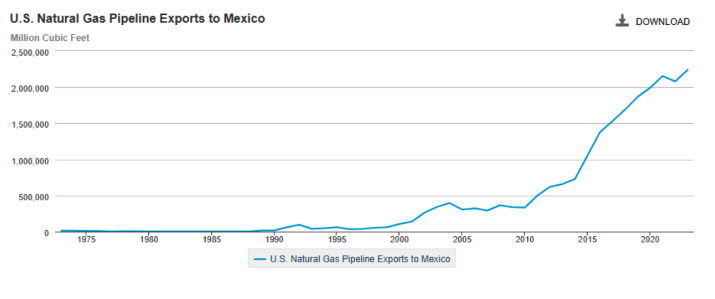
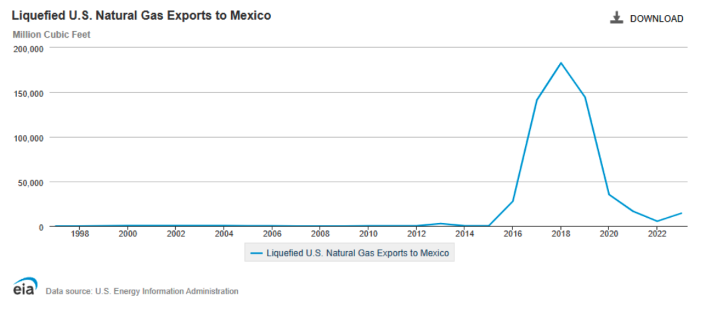
Mexico currently (2023) is importing about 2,241 Billion Cubic Feet annually (BCFY) of US natural gas via pipeline, up from about 658 BCFY in 2013 (EIA) and another 14 BCFY as LNG (Liquified Natural Gas):
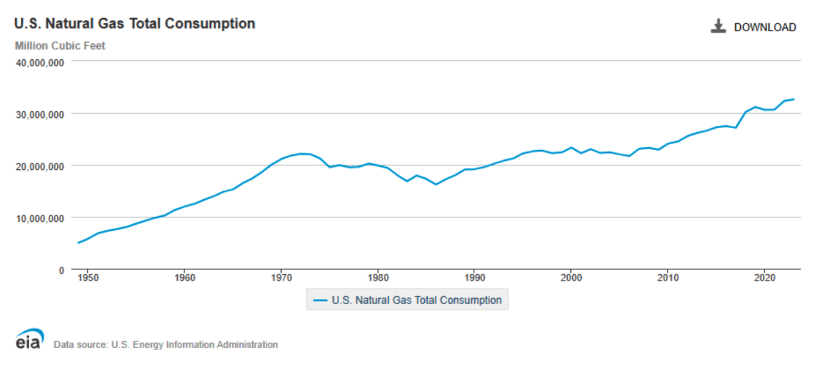
Additionally, US domestic natural gas consumption has consistently increased from the early 2000’s to the present (EIA).
The development and implementation of Emerald’s patented downhole gas/water separation Tool will allow us to produce sustainable natural gas economically, at prices as low as $1.70/MMBTU. Emerald feels there is considerably more upside in natural gas prices than oil prices over the coming years.
If you’d like more information on Emerald or Emerald’s activities, please contact us here.